
CoolNUS BEAM Initiative · NUS Kent Ridge Campus
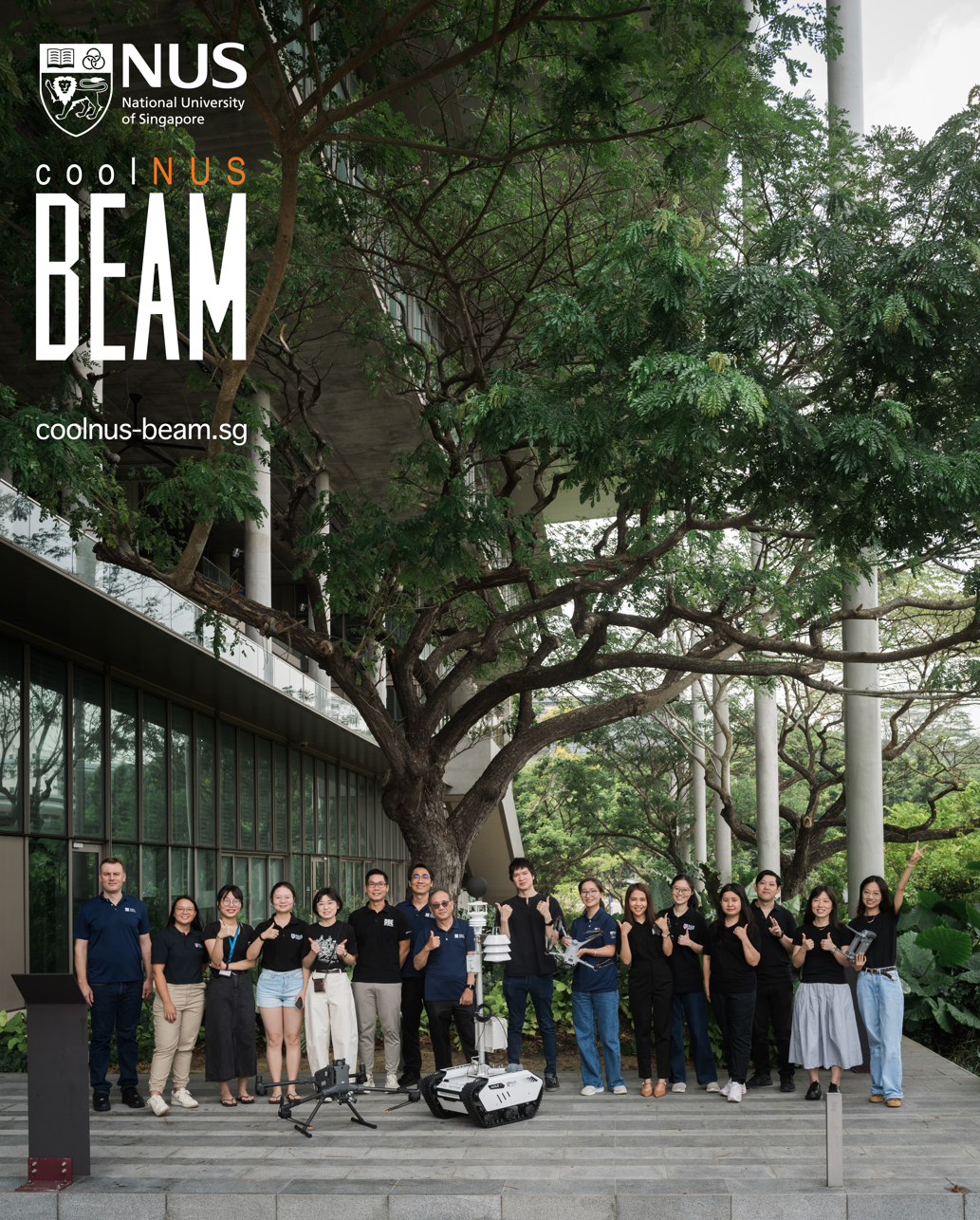
Measuring the Heat.
Building the
Solution.
BEAM is a campus-wide microclimate sensing and urban heat island mitigation initiative at NUS. Through real-time data, digital twin technology, and tested interventions, we are transforming Kent Ridge into a living laboratory for climate resilience.
Institutional Context
Part of NUS's Campus Sustainability Roadmap 2030
The NUS Campus Sustainability Roadmap 2030, led by the University Campus Infrastructure (UCI), sets out four strategic pillars for a greener, smarter, and more resilient university. BEAM is formally positioned under the Defend pillar — Towards a Cool NUS — and also supports the Design and Decarbonise pillars.
Working hand-in-hand with UCI, the BEAM research team turns the campus into a living lab: combining on-site sensing, mitigation testbeds, and a Digital Twin platform to monitor, test, and evaluate real cooling strategies at scale.
Working hand-in-hand with UCI, the BEAM research team turns the campus into a living lab: combining on-site sensing, mitigation testbeds, and a Digital Twin platform to monitor, test, and evaluate real cooling strategies at scale.
University Campus Infrastructure (UCI) is the operational partner of BEAM, facilitating sensor installation approvals, mitigation planning, and engagement with campus stakeholders across NUS Kent Ridge.
UCI Sustainability in Action — An overview of NUS's campus-wide sustainability initiatives, including CoolNUS, under the Campus Sustainability Roadmap 2030.
The Framework
B
Baselining
Assessing historical data to create baseline condition as the basis for benchmarking or comparison for ongoing or future plans.
E
Evaluating
Evaluating baseline results to identify various hot spots or spaces with high thermal condition. Proper mitigation strategies are developed to alleviate issues at these locations.
A
Action
Various mitigation strategies are tested at small or isolated scale to assess the effectiveness and impact on thermal comfort or other target variables.
M
Monitoring
Continuous microclimate monitoring are conducted by several means of long-term data collection throughout the NUS Kent Ridge area.
Phase 1 Impact
Building the Evidence Base.
49,860 m²
Cool paint applied across 7 CDE buildings
Solar reflectance increased from 0.31 to 0.73 on treated façades
~50
Thermal sensors deployed campus-wide
Weather stations, IR cameras, and met towers across NUS Kent Ridge
11
Published & in-review journal articles
Nature Scientific Data · Building & Environment · Sustainable Cities
16
Conference presentations (2023–2025)
ICUC · CISBAT · 3D GeoInfo · PLEA · PVSEC
Baseline
Established
Established
2019–2025 microclimate benchmark
~0.25°C warming per decade at NUS — twice the global average
4
Thermal hotspots identified
Sports courts · Engineering blocks · Science blocks · PGP Residence
Greenery
Database
Database
Campus-wide vegetation inventory
Tree species, canopy coverage, and cooling impact quantified across Kent Ridge
Digital
Twin
Twin
Interactive 3D platform
Live sensor data, thermal maps, greenery layers, and simulation outputs in one platform
Local Climate
Zones
Zones
Campus-specific LCZ framework developed
11 zone types mapped across NUS Kent Ridge — from compact high-rise to tree cover — to guide zone-specific mitigation strategies and inform the campus master plan
Ventilation
Baseline
Baseline
Wind corridor and sea breeze analysis completed
Rooftop and ground-level wind data collected across campus, revealing sea breeze penetration patterns and identifying key ventilation corridors to inform future cooling design
Phase 2 · From January 2026
From Evidence to Action.
Scaling Up for Real-World Impact.
Scaling Up for Real-World Impact.
Building on Phase 1's sensing foundation, BEAM Phase 2 shifts focus to translational research — moving from data collection to guidelines, predictive tools, and design decisions that directly inform the NUS campus master plan and sustainability roadmap. Phase 2 runs from January 2026, led by two new Principal Investigators alongside the broader BEAM team.
Phase 2 Principal Investigators
Principal Investigator
Asst. Prof. Ang Yu Qian
Presidential Young Professor at the Department of the Built Environment, NUS College of Design and Engineering. Founder of the City Syntax Lab, specialising in urban building energy modelling, carbon reduction for cities, and AI for urban systems. Consulted for the World Bank in AI and data science workstreams.
View Profile ↗
Principal Investigator
Asst. Prof. Chew Lup Wai
Assistant Professor and PI of the Airflow-Buildings-Cities Laboratory at NUS. PhD in Mechanical Engineering from MIT; postdoctoral scholar at Stanford University. Specialises in urban airflow modelling, natural ventilation, outdoor wind fields, and the physics of urban flows.
View Profile ↗
Phase 2 Objectives
Phase 2 is guided by three core principles: evidence-based experimentation with clear hypotheses and control sites; target-setting methodology linking interventions directly to measurable improvements in outdoor thermal comfort (OTCI); and translational research that embeds findings into campus planning through the LCZ framework, Digital Twin platform, and NUS Sustainability Roadmap 2030.
01
Evidence-based experimentation — clear hypotheses, treatment and control sites, and rigorous statistical methods across all work packages.
02
Target-setting methodology — linking interventions directly to quantifiable improvements in OTCI and PPD to justify campus comfort targets.
03
Translational research — embedding findings into campus planning via the LCZ framework, Digital Twin v2, and the NUS New Masterplan.
5 Main Work Packages
WP 01
CVent
Campus Ventilation
Focus
Airflow & Urban Form
Breezeways & wind corridors · CFD-based ventilation assessment · Walkway ventilation & comfort · Design & planning guidelines
WP 02
GIG
Greenery Insights & Guidelines
Focus
Campus Greenery
Greenery database · Cooling impact · Tree placement optimisation · Tree planting guidelines · Support 120,000 tree campaign
WP 03
UBEM
Urban Building Energy Modeling
Focus
Energy & Decarbonisation
Campus-scale energy modelling · Microclimate-informed simulations · Cooling load & intervention testing · Decision support for net-zero planning
WP 04
WalkX
Walkability Analytics eXplorer
Focus
People & Thermal Comfort
Thermal walks & perception data · Walkability & heat exposure · AI-based comfort prediction · Health, mobility & campus experience
WP 05
CT
ClimaTwin
Focus
Prediction Model
AI-driven microclimate prediction · 3D campus + greenery database · Scenario testing & forecasting · Real-time decision intelligence
Climate change is a global challenge impacting every part of the planet. One critical aspect is the urban heat island (UHI) effect. Addressing this issue requires collaboration and robust data sharing.
Our mission is to raise awareness about the climate emergency and find practical solutions. Similarly, our aim is to promote collaboration among the bright minds at NUS, using the campus as a living lab and test bed to assess urban heat island effects and thermal comfort issues through the BEAM framework.